How to Redesign Your Travel Website Without Losing Your Google SEO Rankings
A website redesign is exciting, but a botched migration can destroy years of organic SEO work. Learn how to map redirects, preserve content equity, and update your site safely.
A beautiful, modern website redesign can completely transform your travel brand. However, if your launch is not handled with extreme care, you run the risk of losing years of organic search engine optimization (SEO) visibility overnight.
For high-end safari lodges and tour operators, organic search traffic is highly profitable. These are travelers actively searching Google for terms like "best luxury lodge in Sabi Sands" or "private Kruger safari packages." When you rebuild your website, your pages often change paths, URLs are updated, and content is rearranged. If Google’s crawlers encounter broken links and missing pages, your keyword rankings will collapse. In this step-by-step guide, we break down exactly how to migrate and redesign your travel site without dropping your hard-earned Google rankings.
1. The Golden Rule of Redesigns: Maintain Your URL Structure
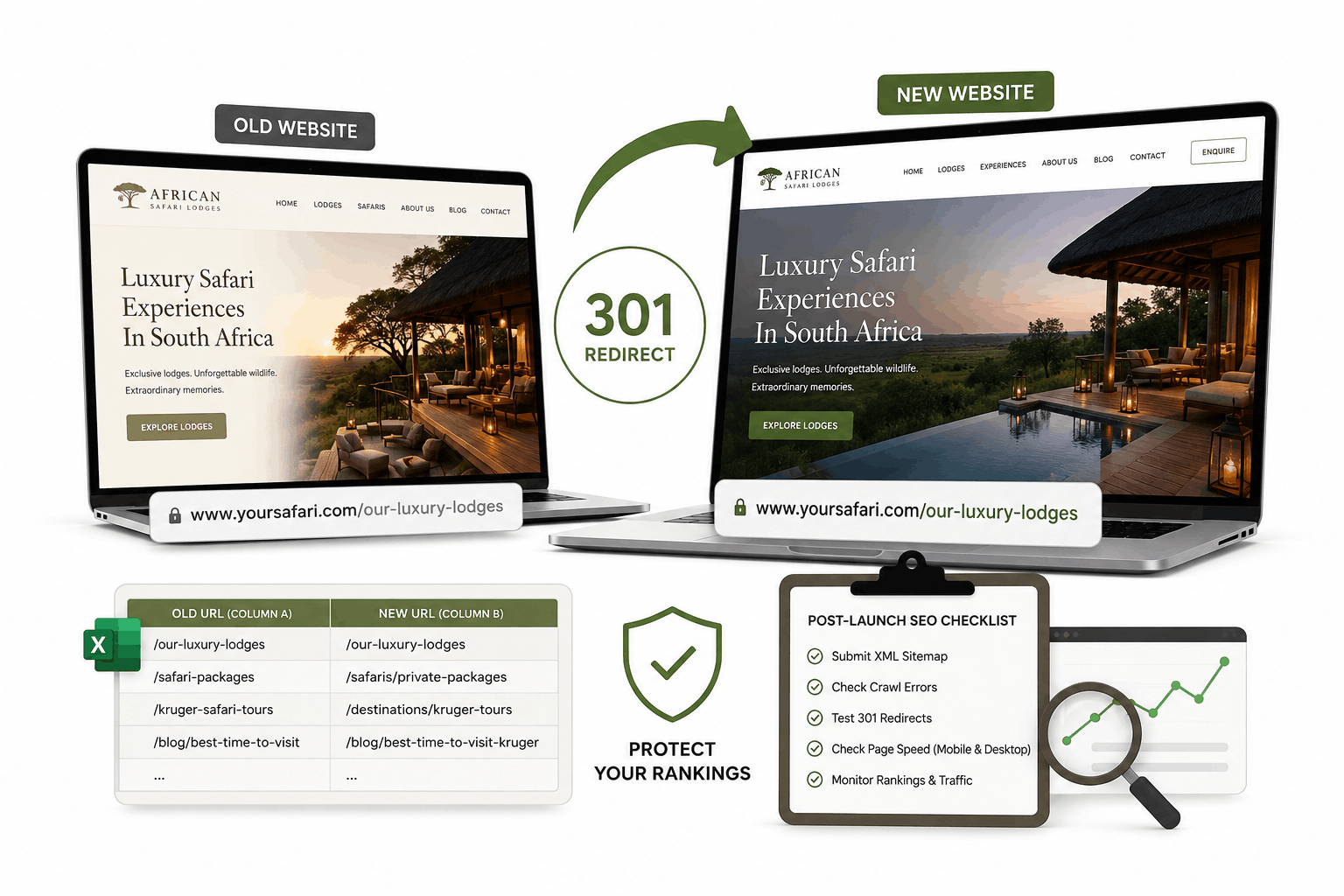
If you have an existing page that ranks at the top of Google for a highly competitive keyword, your absolute best option is to keep that page's URL exactly the same on your new website. If your current page is /our-luxury-lodges, do not change it to /lodges/luxury-safari-suites on the new site unless it is absolutely necessary.
Changing the URL forces search engines to index a brand-new page and evaluate its authority from scratch, which almost always results in a temporary dip in organic traffic.
2. Map 301 Redirects Diligently
If you must change your URL structure to make it cleaner, you must use 301 (permanent) redirects. A 301 redirect tells Google’s crawler: "The page that used to live at URL A has moved permanently to URL B. Please pass all its search authority to the new location."
Create a spreadsheet before you write a single line of new code. List every single indexed URL from your current site in Column A, and map it directly to its exact replacement on the new site in Column B. Never redirect all your old pages to your new home page—this is a shortcut that Google treats as a soft 404 error, which ruins your rankings. If you need assistance with this transition, we offer specialized website migration services to ensure your traffic remains completely intact.
3. Don't Strip Out Your Ranking Content
A common mistake in modern web redesigns is prioritizing minimalist design over valuable text content. While clean, visually-driven layouts are excellent, stripping out 500 words of informative, keyword-rich text because "it looks too crowded" will destroy your SEO.
Google relies on on-page text to understand what your website is about. Maintain your key headings, preserve the structured content that made your pages rank in the first place, and look for ways to expand your depth rather than shrinking it. We custom build modern travel agency websites that perfectly balance breathtaking, minimalist design with dense, highly structured, SEO-friendly content.
4. Run Post-Launch Technical SEO Audits
The moment your new site goes live, your job is only half done. You must immediately monitor Google Search Console for crawl errors, submit your new XML sitemap, and test your page speeds on both desktop and mobile devices. Identifying and fixing any minor site speed hiccups or broken links within the first 48 hours is critical to maintaining your search visibility. You can read more about how our structured technical audits are priced in our breakdown of web design prices in Cape Town.
LET’S TALK
Have a project in mind after reading this? Send a brief and I usually reply within 24 to 48 hours.