The ROI of a Tourism Web Redesign: Direct Bookings vs. OTA Commissions
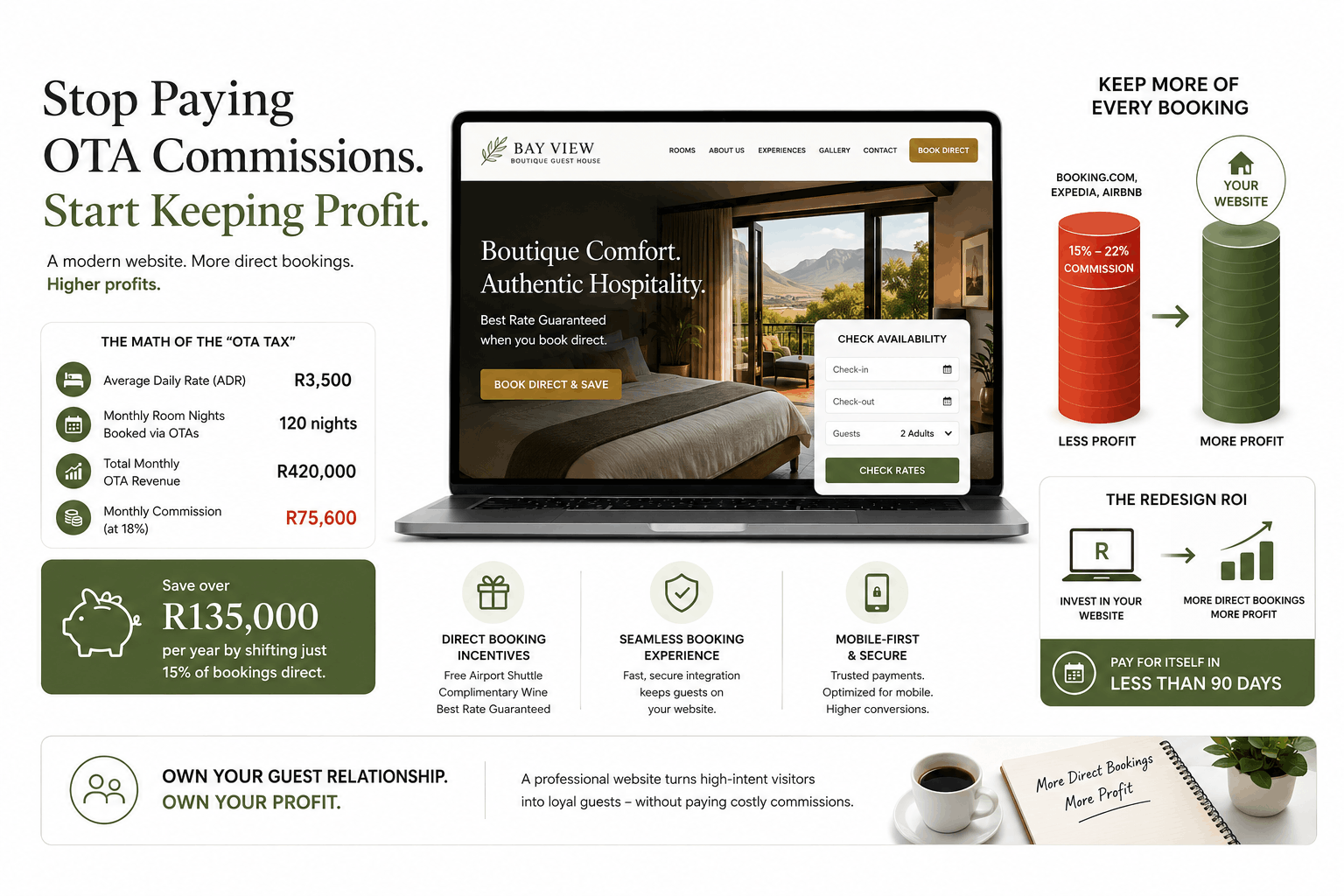
Stop paying a 15% to 20% OTA Tax to Booking.com. Discover how a modern website redesign pays for itself by shifting reservations directly to your own booking engine.
For guest houses, boutique hotels, and lodges across South Africa, commissions paid to Online Travel Agencies (OTAs) like Booking.com, Expedia, and Airbnb are often one of the single largest operating expenses on the balance sheet.
While OTAs are an essential tool for filling rooms during off-peak seasons, relying on them as your primary source of guests is incredibly expensive. In 2026, OTA commissions average between 15% and 22% per transaction. If your average booking value is R20,000, you are handing over up to R4,400 of pure profit to a third-party platform for every reservation they deliver. In this article, we break down the real mathematics behind a professional website redesign and show you how optimizing your booking path yields a rapid, measurable return on investment (ROI).
1. The Math of the "OTA Tax"
To understand the value of a redesign, let’s look at a typical scenario for a 10-room guest house in Cape Town or Franschhoek:
Average Daily Rate (ADR): R3,500
Monthly Room Nights Booked via OTAs: 120 nights
Total Monthly OTA Revenue: R420,000
Monthly Commission (at 18%): R75,600
Over a single year, this guest house pays more than R900,000 in commissions. If a modern, high-converting website can shift just 15% of those bookings from OTAs directly to your own site, you save over R135,000 annually. This means a high-end web redesign doesn't just look pretty—it pays for itself within the first few months of launching. To see how these costs scale, check out our comprehensive guide on web design pricing in Cape Town.
2. The Psychology of the Direct Booking Path
Why do travelers use Booking.com instead of booking directly with you? It boils down to trust, speed, and ease of use. If a potential guest discovers your property on an OTA, they will almost always search for your official website to look for better photos, more information, or exclusive direct-booking specials. This is called the "Billboard Effect."
However, if your site is slow, difficult to navigate, or fails to clearly showcase your unique selling points, the user will quickly return to the safety of the OTA. A professional website design for hotels and guest houses focuses on capturing these high-intent visitors immediately with a seamless, polished, and mobile-responsive layout.
3. Key Design Features That Shift the Mix
To successfully capture direct reservations, your website must actively compete with the slick user experience of global platforms. We build sites incorporating several crucial direct-booking triggers:
Direct Booking Incentives: Prominently display value-adds like "Free Airport Shuttle," "Complimentary Bottle of Wine," or "Best Rate Guaranteed" alongside your booking triggers.
Seamless Widget Integration: Eliminate clunky, slow-loading redirection paths by custom-styling your booking engine. Learn more about how we implement unified booking integrations that keep visitors on your domain.
Mobile-First Security: Build high-trust payment security badges and clear checkout layouts that reduce cart abandonment on smartphones.
4. The Redesign Cost vs. Value Equation
When you treat your website as a revenue-generating asset rather than a digital business card, the decision to redesign becomes simple. Rather than viewing the project as an upfront expense, smart operators calculate the exact number of room-nights they need to claw back from OTAs to pay off the design work. For most boutique properties, that target is reached in less than 90 days.
LET’S TALK
Have a project in mind after reading this? Send a brief and I usually reply within 24 to 48 hours.