Tourism SEO in South Africa 2026: How Hotels, Guest Houses and Tour Operators Rank on Google
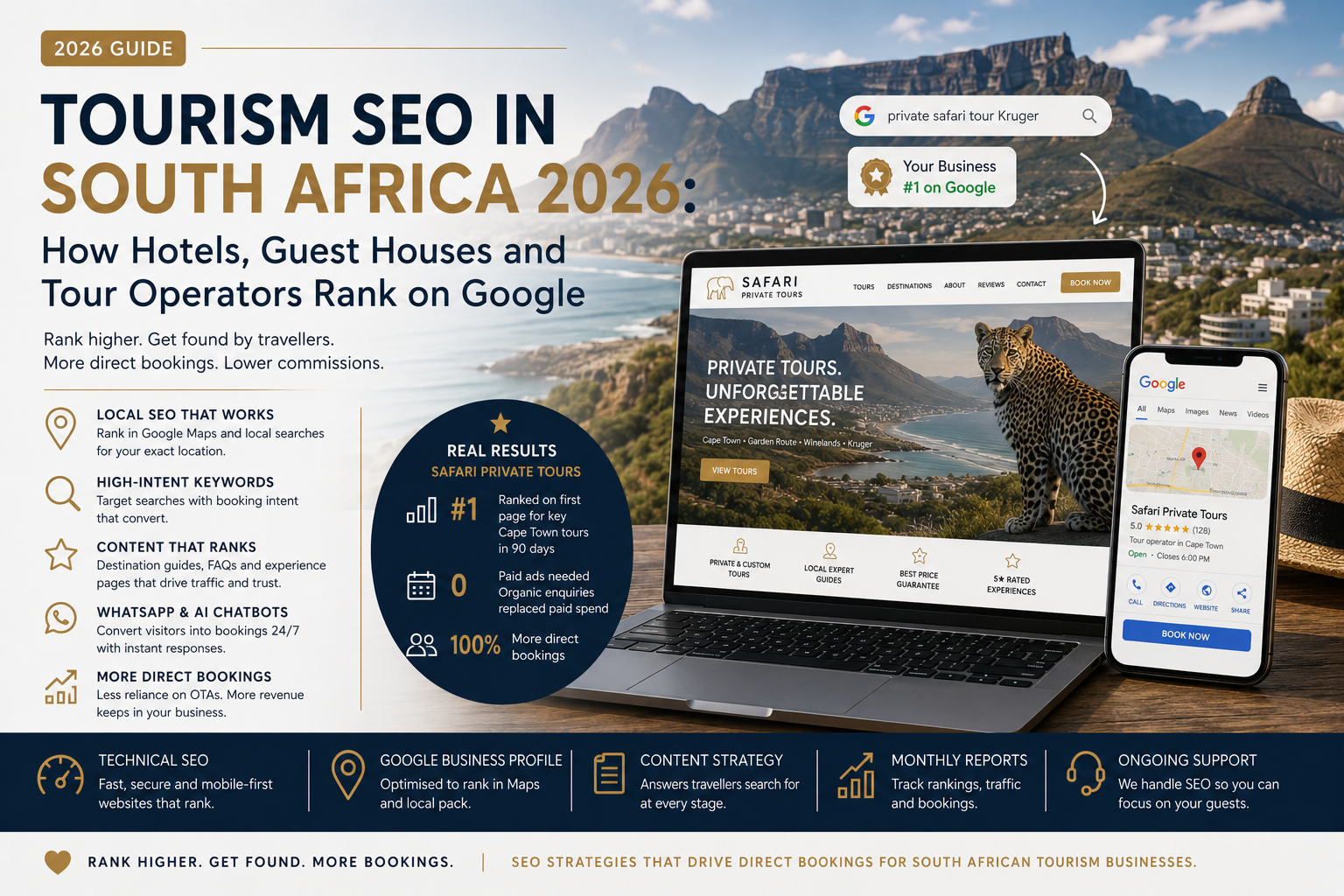
Hotels, guest houses and tour operators in South Africa are losing direct bookings to OTAs every day because they don't rank on Google. Here's the complete SEO guide for South African tourism businesses in 2026.
Tourism SEO in South Africa 2026: How Hotels, Guest Houses and Tour Operators Rank on Google
Every day, thousands of travellers open Google and search for accommodation, tours, and experiences in South Africa. They type "boutique hotel Cape Town Waterfront", "private safari tour Kruger", "guest house Franschhoek with pool". The businesses that appear on the first page get the enquiry. Everyone else gets nothing.
Most South African tourism businesses are not on the first page. They rely on Booking.com, Airbnb, Viator, and GetYourGuide to be found — and then pay 15–25% commission on every booking those platforms generate. SEO is the way out. It is the only channel that builds a compounding asset: once you rank, you get bookings without paying per click or per reservation.
This is the complete SEO guide for South African hotels, guest houses, and tour operators in 2026.
Why Tourism SEO in South Africa Is Different
Tourism searches are intent-driven in a way that most industries are not. When someone searches "private Cape Town tour operator" or "guest house Knysna Garden Route", they are not browsing. They are actively planning and close to booking. Ranking for these searches means reaching a buyer at exactly the right moment.
South African tourism SEO has two distinct audiences to optimise for simultaneously: international travellers researching from Europe, the UK, and North America, and domestic travellers searching from Johannesburg, Pretoria, and Durban. The search phrases, the booking lead times, and the trust signals that convert them are different. Your SEO strategy needs to account for both.
The other factor that makes South African tourism SEO unique is the dominance of OTAs in search results. Booking.com, TripAdvisor, SafariNow, and LekkeSlaap all spend heavily on SEO and paid search. Independent properties cannot outrank them for generic terms like "hotels in Cape Town" — but they can absolutely outrank them for specific, location-based, and experience-based searches where the OTAs have thin content.
The Foundation: Technical SEO Your Tourism Website Must Get Right
Before any content strategy works, the technical foundation has to be solid. A slow, broken, or poorly structured website will not rank regardless of how good the content is.
Page speed on mobile data is the single most important technical factor for South African tourism websites. International guests research on desktop but domestic travellers browse heavily on mobile over mobile data. A hotel website that takes more than four seconds to load on LTE loses most of its mobile visitors before the page renders. Google uses page speed as a direct ranking signal — a slow site ranks lower regardless of content quality.
Mobile-first design is non-negotiable. Over 60% of travel research happens on mobile devices. If your booking form, room pages, and gallery do not work properly on a mid-range Android phone, you are broken for the majority of your visitors. See the full hotel website design guide for South Africa (https://tendaigumunyu.co.za/blog/hotel-website-design-south-africa-2026) for what a properly built hospitality website looks like in 2026.
SSL and HTTPS are table stakes. A website showing "Not Secure" in the browser kills trust immediately and is penalised in Google rankings. Any developer worth hiring will have this sorted from day one.
Structured data markup helps Google understand what your business is — a hotel, a guest house, a tour operator — and display rich results like star ratings, price ranges, and review scores directly in search results. Most South African tourism websites have no structured data at all. This is a straightforward technical win.
The full technical checklist is covered in the guide on how to build a website in South Africa in 2026 (https://tendaigumunyu.co.za/blog/how-to-build-a-website-south-africa-2026).
Local SEO: The Highest-Return Strategy for South African Tourism
Local SEO is where most South African hotels, guest houses, and tour operators have the biggest gap — and the biggest opportunity.
Google Business Profile is the starting point. A fully completed profile with real photos, accurate categories, your exact location pin, your booking link, and responses to every review is the single most impactful free SEO action any hospitality business can take. Properties with complete, active Google Business Profiles appear in the map pack — the three listings that appear above the organic results for location searches. Map pack placement drives enormous booking volume.
Location keywords in your content seem obvious but most tourism websites get this wrong. Your homepage title should include your specific location — not just "Cape Town" but "V&A Waterfront", "Camps Bay", "Franschhoek wine estate", "Garden Route". Your room pages, your about page, and your FAQ should all reference the exact areas and landmarks your guests will be searching for.
Neighbourhood and experience content is where independent properties beat OTAs. A blog post titled "What to Do Near Kalk Bay: A Local's Guide" or "The Best Wine Farms Within 20 Minutes of Franschhoek" targets exactly the searches travellers use when trip-planning — and it positions your property as the trusted local authority, not just a listing on a booking platform.
Keyword Strategy: What South African Travellers Actually Search
The keyword approach that works for South African tourism businesses in 2026 is built around three layers.
High-intent location searches are the foundation — "guest house Hermanus", "private tour Table Mountain", "luxury boutique hotel Cape Winelands". These are the searches where someone is ready to book. Your service pages and room pages should be optimised for these.
Long-tail experience searches are where organic traffic compounds — "family-friendly accommodation Garden Route with pool", "Cape Town day tour including Cape of Good Hope and penguins", "wine tasting tour from Cape Town". These searches have lower volume but much higher conversion rates because the searcher knows exactly what they want. OTAs have thin content for these — a well-written, specific page on your own site can rank above them.
Research-phase content builds authority and captures travellers earlier in their planning journey — "best time to visit Cape Town", "what to pack for a South African safari", "how many days do you need in the Winelands". These searches bring in international travellers months before they book. If your blog answers these questions well, your property is in their consideration set from the start.
The Safari Private Tours project (https://tendaigumunyu.co.za/projects/safari-private-tours) is a live example of this approach working in the Cape Town market — ranking on the first page for "private tours Cape Town" and "Cape of Good Hope tour" within 90 days of launch, with organic enquiries replacing paid ad spend entirely.
Content Strategy: What to Publish and How Often
Tourism businesses that rank consistently publish content that answers the real questions their guests search for. This does not mean publishing a generic blog every week. It means building a content library that covers every stage of the guest journey.
Destination guides targeting your specific area perform exceptionally well for tourism SEO. A Cape Town guest house writing a thorough guide to the best restaurants within walking distance, the best beaches by time of day, and what to do on a rainy day in Cape Town builds topical authority that generic OTA listings cannot replicate.
Tour and experience pages should each have their own dedicated URL with full descriptions, itineraries, pricing guidance, and genuine photography. Listing all tours on a single generic "Packages" page — which most tour operator websites do — limits ranking potential dramatically. Each experience deserves its own page optimised for the specific search phrase a traveller would use.
FAQ content is one of the highest-returning content investments for South African tourism businesses. Google pulls FAQ content directly into search results as featured snippets. Questions like "Is Cape Town safe for tourists in 2026?", "Do I need a visa to visit South Africa from the UK?", and "What is the best time of year to see whales in Hermanus?" are searched thousands of times per month. The business that answers them clearly and specifically ranks and gets the click.
Review response content is underused. Responding to Google and TripAdvisor reviews with specific, detailed responses — mentioning room names, locations, and experiences — adds keyword-rich content to your profile that supports local SEO.
WhatsApp and AI: Turning SEO Traffic Into Bookings
SEO brings the visitor to your website. What happens next determines whether they book directly or go back to Booking.com.
South African travellers book over WhatsApp. International guests who arrive in South Africa quickly adopt it too. A WhatsApp chat button on every page of your website — visible on mobile, easy to tap — converts SEO traffic into direct enquiries without a contact form or a 48-hour response window.
An AI WhatsApp chatbot takes this further. The Beatrice Guest House (https://tendaigumunyu.co.za/projects/beatrice-guest-house) deployed an AI chatbot that handled 312 bookings without human intervention within 60 days. Average response time dropped from 4 hours to 11 seconds. No-shows fell 22% because the bot sends an automated WhatsApp confirmation 24 hours before check-in. SEO brought the traffic — the chatbot converted it at any hour of the day.
The full guide on AI chatbots for South African hospitality businesses (https://tendaigumunyu.co.za/blog/ai-chatbots-south-african-business-2026) covers exactly how this works and what it costs to implement.
How Long Does Tourism SEO Take to Work?
Technical fixes and Google Business Profile improvements show up in Search Console within two to four weeks. Local map pack rankings for specific location searches typically move within four to eight weeks of consistent optimisation. Competitive organic rankings for high-volume searches take three to six months to build.
The businesses that get frustrated with SEO and abandon it at month two are the ones who remain fully dependent on OTA commissions for the next decade. The businesses that commit to a six-month SEO strategy own a compounding asset that brings in direct bookings indefinitely.
For tour operators specifically, the guide on how to get more direct bookings in Cape Town (https://tendaigumunyu.co.za/blog/direct-bookings-tour-operators-cape-town-2026) covers the full direct booking strategy beyond SEO.
What Does Tourism SEO Cost in South Africa in 2026?
A focused SEO retainer for a South African hotel, guest house, or tour operator — covering technical SEO, Google Business Profile management, content production, and monthly reporting — typically runs R5 000–R18 000 per month depending on competition level and content volume required.
One-time SEO audits and setup packages for smaller properties run R4 000–R12 000 and give you a prioritised action list you can implement yourself or hand to a developer.
Compare this to the commission cost on a single busy December weekend for a Cape Town guest house paying 18% to Booking.com — SEO pays for itself quickly when it replaces even a fraction of that OTA dependency.
The full breakdown of what digital services cost in South Africa in 2026 is in the website design prices guide (https://tendaigumunyu.co.za/blog/website-design-prices-south-africa-2026).
Frequently Asked Questions
Can a small guest house compete with Booking.com on Google?
Not on generic terms like "hotels Cape Town" — but absolutely on specific location and experience searches. "Guest house with mountain views Camps Bay" or "self-catering cottage Hermanus seafront" are searches where a well-optimised independent property page outranks an OTA listing every time. The OTAs have breadth; you have depth and specificity.
How many blog posts do I need to rank?
Quality beats quantity every time. Five thoroughly researched, genuinely useful pieces of content targeting specific search phrases your guests use will outperform fifty generic posts. Start with your most-searched destination questions and your most specific experience searches.
Should I focus on Google or TripAdvisor for tourism SEO?
Both, but prioritise Google. Google controls the entry point for most travel searches. TripAdvisor ranks well within Google results and a strong TripAdvisor profile supports your Google Business Profile authority. Manage both — but your own website ranking on Google is the asset you own outright.
Do I need a separate SEO strategy for international and domestic guests?
Your content strategy should address both audiences, but the technical and local SEO foundation serves both. International travellers search in English with destination-specific phrases. Domestic travellers search in English too but with price-conscious and proximity-based phrases. One well-structured website with the right content covers both.
Is it worth hiring an SEO specialist or can I do it myself?
The Google Business Profile, review responses, and basic content updates are DIY-friendly. Technical SEO, site speed, structured data, and competitive keyword strategy require a specialist. Attempting technical SEO without the right skills often introduces new problems. See what to look for in the best web developer in Cape Town (https://tendaigumunyu.co.za/blog/best-web-developer-cape-town-2026) when hiring someone to handle this.
Continue Reading
Hotel Website Design in South Africa 2026: What Guests Expect Before They Book How to Get More Direct Bookings for Your Cape Town Tour Business AI Chatbots for South African Businesses 2026 Top 10 Website Mistakes South African Businesses Make in 2026 SEO in South Africa 2026: Rank on the First Page Website Design Prices in South Africa 2026: Complete Cost Guide
Need help? Get in touch or explore services and projects. Ready to talk? Book a consulting call.
LET’S TALK
Have a project in mind after reading this? Send a brief and I usually reply within 24 to 48 hours.