How to Get More Direct Bookings for Your Cape Town Tour Business in 2026 (Without Paying OTA Commission)
Viator and GetYourGuide take 20–30% of every booking. Here is how Cape Town tour operators and travel agents are building direct booking channels in 2026 — and keeping the full margin.
How to Get More Direct Bookings for Your Cape Town Tour Business in 2026 (Without Paying OTA Commission)
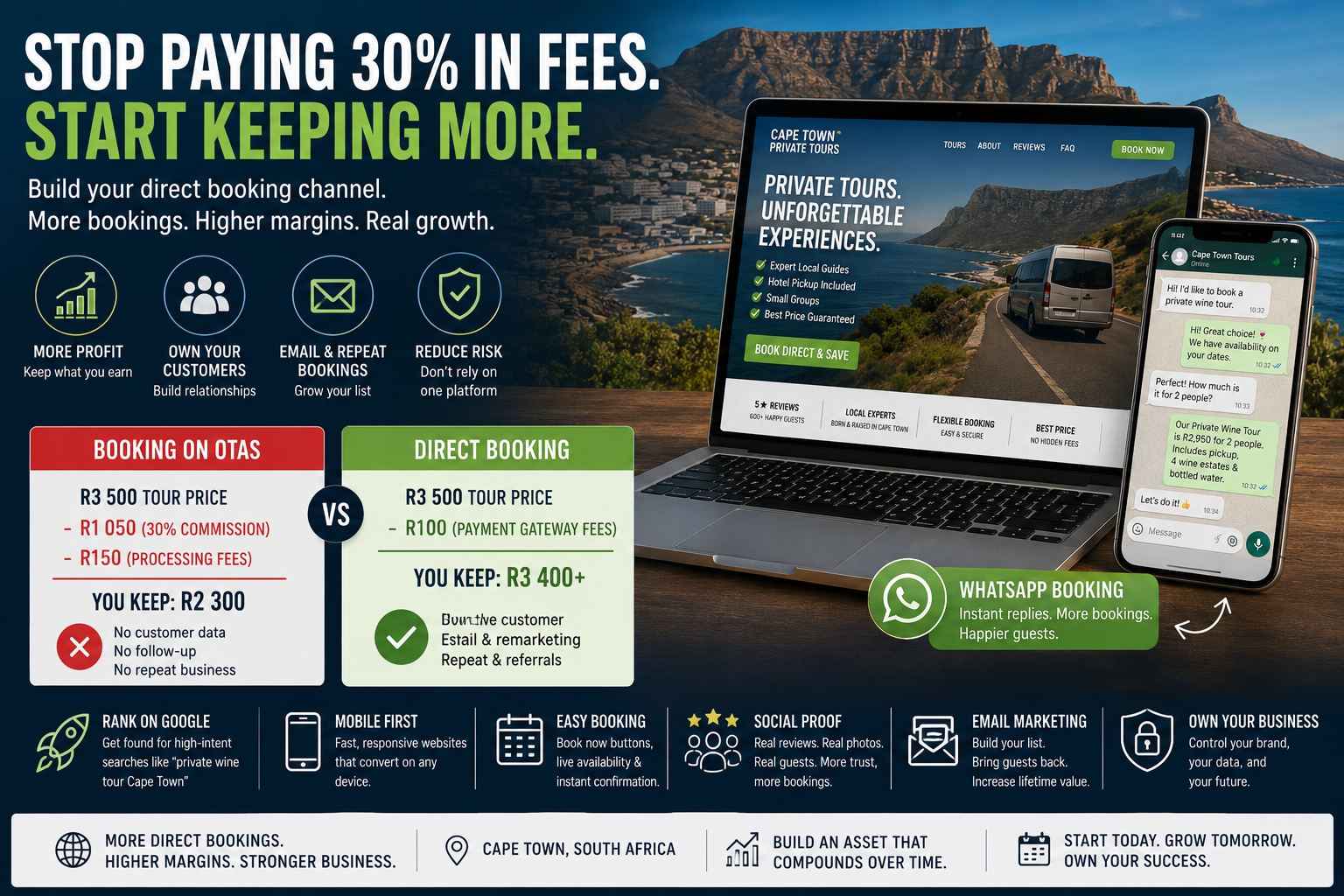
Every time a guest books your Cape Town tour through Viator or GetYourGuide, you hand over 20 to 30% of that booking before you have paid a single guide, filled a single tank, or poured a single wine. On a R3 500 private tour, that is R700–R1 050 gone before the day starts. Multiply that across a full season and you are paying the OTAs more than you pay most of your staff.
This is not an article about abandoning OTAs. They provide real discovery value, especially for new operators building a reputation. This is about building a direct booking channel alongside them — so that over time, the ratio shifts in your favour, your margins improve, and your business stops being held hostage to the next commission increase.
The Real Cost of OTA Dependency
The commission itself is the obvious cost. What most tour operators do not account for is everything that comes with it.
When a guest books through Viator or GetYourGuide, the OTA owns the customer relationship. You get a name and a pickup time. You do not get their email address for remarketing. You cannot follow up after the tour to offer your wine tasting extension. You cannot build a loyalty loop that brings them back on their next Cape Town visit or turns them into a referral source. Every booking starts from zero.
There is also platform risk. OTA algorithms change. Commission rates increase — GetYourGuide raised commission rates for many operators in 2025. Ranking drops happen without warning. An operator who built 80% of their bookings on a single OTA platform discovered exactly how fragile that is the first time their listing was suppressed after a policy change.
A direct booking channel is not just cheaper per booking. It is a business asset that compounds over time.
Why Most Tour Operator Websites Do Not Convert
The reason most Cape Town tour operators do not get enough direct bookings is not because travellers prefer OTAs. It is because their websites make it too hard to book directly.
The typical tour operator website in South Africa was built once, handed over, and never properly optimised. It loads slowly on mobile data. There is no clear booking button above the fold. The pricing is buried or missing entirely. There is no WhatsApp option for guests who want to ask a quick question before committing. And it does not rank on Google for the searches that matter — so guests who would happily book direct never find it in the first place.
Compare that to what the OTA offers: fast load speed, mobile-optimised checkout, instant confirmation, reviews front and centre, and 15 years of SEO authority behind every listing. Your direct website needs to compete on all of those dimensions. See the top 10 website mistakes South African businesses make to audit where yours is falling short right now.
What a High-Converting Tour Operator Website Looks Like in 2026
The websites that consistently generate direct bookings share the same characteristics regardless of whether they sell private safaris, wine tours, or Cape of Good Hope day trips.
They load fast on mobile. Over 80% of South African internet users browse on mobile, and a significant portion of international guests researching Cape Town tours are doing so from their phones while still planning the trip. A page that takes more than 3 seconds to load on LTE loses most of those visitors before the images finish rendering.
They lead with the outcome, not the operator. Guests do not arrive at your website to learn about your company history. They arrive because they want a specific experience. Lead with "Private Table Mountain Tour — Small Group, Expert Guide, Hotel Pickup Included" not "Welcome to Cape Town Adventure Tours, established 2011."
They make the price visible. Hiding pricing behind an enquiry form is one of the fastest ways to send a guest back to Viator, where every listing shows the price immediately. Be upfront. Guests who see your pricing and stay are more qualified than guests who enquire and ghost.
They have one clear action on every page. Book now. WhatsApp us. Get a quote. Pick one per page and make it impossible to miss. Every extra option reduces the chance of any action being taken.
They show social proof immediately. Reviews, photos from real guests, and specific testimonials — not generic stock imagery. A guest comparing your direct website to your Viator listing will book direct when your website feels more trustworthy, not less. See the full guide on how to build a website in South Africa in 2026 for the complete technical checklist.
SEO: The Long Game That Pays Forever
Paid ads stop the moment you stop paying. OTA listings depend on their algorithm, not yours. SEO builds an asset that compounds — a page that ranks for "private wine tour Cape Town" in 2026 will still be sending you free bookings in 2029 if you maintain it.
The searches that tour operators need to rank for are high-intent and specific. Travellers do not search for "things to do Cape Town" when they are ready to book — they search for "private Cape of Good Hope tour", "half day Table Mountain hike with guide", or "Stellenbosch wine tasting tour for two". These are buyer-intent searches from people with credit cards open and dates in mind.
Most tour operator websites rank for none of them because their pages are written for humans to read, not structured for Google to understand. Each tour needs its own dedicated page with the destination and tour type in the title, heading, and URL. Reviews need to be implemented with structured data so Google shows your star rating in results. Your Google Business Profile needs to be fully complete and actively managed with photos and responses to every review.
Read the complete SEO guide for South Africa in 2026 for the full strategy applied specifically to the South African search landscape.
WhatsApp: The Fastest Way to Convert International Enquiries
International guests planning a Cape Town trip are in a different timezone, often with questions before they commit to a booking. A contact form that promises a reply within 24–48 hours loses that booking to the OTA every time. WhatsApp changes that entirely.
A WhatsApp button on every page of your website allows a guest in London at 10pm their time — which is midnight South African time — to send a quick message. With an AI-powered chatbot on WhatsApp, that message gets an intelligent response immediately: tour availability, pricing, pickup options, what to bring. The guest gets what they need. The booking happens.
This is exactly what the Beatrice Guest House project demonstrated: response time dropped from 4 hours to 11 seconds after a WhatsApp AI chatbot was deployed, and 312 bookings were handled in the first 60 days without human intervention. The same principle applies directly to tour operators fielding international enquiries across time zones.
See the full breakdown of AI chatbots for South African businesses to understand how this works in practice and what it costs to build.
Email: The Asset OTAs Cannot Take From You
Every direct booking gives you something Viator never will — a customer email address you own. A well-managed email list of past guests is one of the most valuable assets a tour operator can build.
A guest who did your private wine tour in the Franschhoek Valley and had a great experience is your most likely next customer. They will book again on their next visit. They will refer friends. They will respond to a seasonal offer. None of that is possible if every booking came through an OTA and you have no way to reach them.
The simplest system: after every direct booking, send a post-tour follow-up email 24 hours after the experience. Ask for a Google review. Offer a referral discount for their next Cape Town visit. Add them to a low-frequency newsletter — one email per quarter with a seasonal offer is enough. The cost is near zero. The compounding effect over three years is significant.
The Direct Booking Stack for a Cape Town Tour Operator
These are the five components that work together to build a direct booking channel.
A fast, mobile-optimised website with clear pricing, a booking widget, and a WhatsApp button on every page. This is the foundation everything else depends on.
SEO targeting the specific searches your ideal guests use when they are ready to book — not generic destination content, but tour-specific pages with structured data and local optimisation.
A fully completed Google Business Profile that is regularly updated with fresh photos and responded to on every review. This is free and has a direct impact on how visible you are in local map results.
A WhatsApp chatbot that handles after-hours enquiries, qualifies leads, and confirms bookings without requiring you or your team to be online at midnight.
An email capture and follow-up sequence that turns first-time direct bookers into repeat customers and referral sources.
None of this requires a large budget. It requires building it properly once and maintaining it consistently. See real examples of what this looks like in the projects portfolio — including the Safari Private Tours build, which was designed specifically to generate direct bookings for a Cape Town tour operator.
Real Example: Safari Private Tours
The Safari Private Tours website was built with one goal: generate direct bookings from international guests searching for private Cape Town tours. The site was structured around high-intent search terms, loaded fast on mobile, showed pricing clearly, and made WhatsApp the primary contact method. Within 90 days of launch, it ranked on the first page for target searches and organic enquiries replaced paid ad spend entirely. That is the compounding effect of a direct booking channel built properly from the start.
Frequently Asked Questions
Should I stop listing on Viator and GetYourGuide?
No — not immediately and possibly not ever. OTAs provide genuine discovery value, especially for reaching international guests who would never have found you otherwise. The goal is to shift your booking mix over time so that direct bookings grow as a percentage while OTA bookings remain a secondary channel, not the primary one.
How long does it take to build a direct booking channel?
A well-built website with basic SEO can start generating direct enquiries within 4 to 8 weeks of launch. Meaningful organic search rankings take 3 to 6 months to develop. A WhatsApp chatbot can be live within two weeks. The email system is running from your first direct booking. Start now — the compounding starts from day one.
What does it cost to build a direct booking website for a tour operator?
A focused direct booking website for a Cape Town tour operator typically costs R12 000–R45 000 to build depending on the number of tours and integrations required, and R2 500–R6 000/month for SEO and ongoing maintenance. At current OTA commission rates, most operators recover the build cost within one season if the site converts well. See website design prices in South Africa 2026 for a full cost breakdown.
Do I need a booking engine on my website or can I just use WhatsApp?
Both. A booking engine handles guests who want to book instantly without human interaction — typically international guests booking from a different timezone. WhatsApp handles guests with questions before they commit. The combination covers the full range of guest behaviour and significantly outperforms either channel alone.
Can I build this myself or do I need a developer?
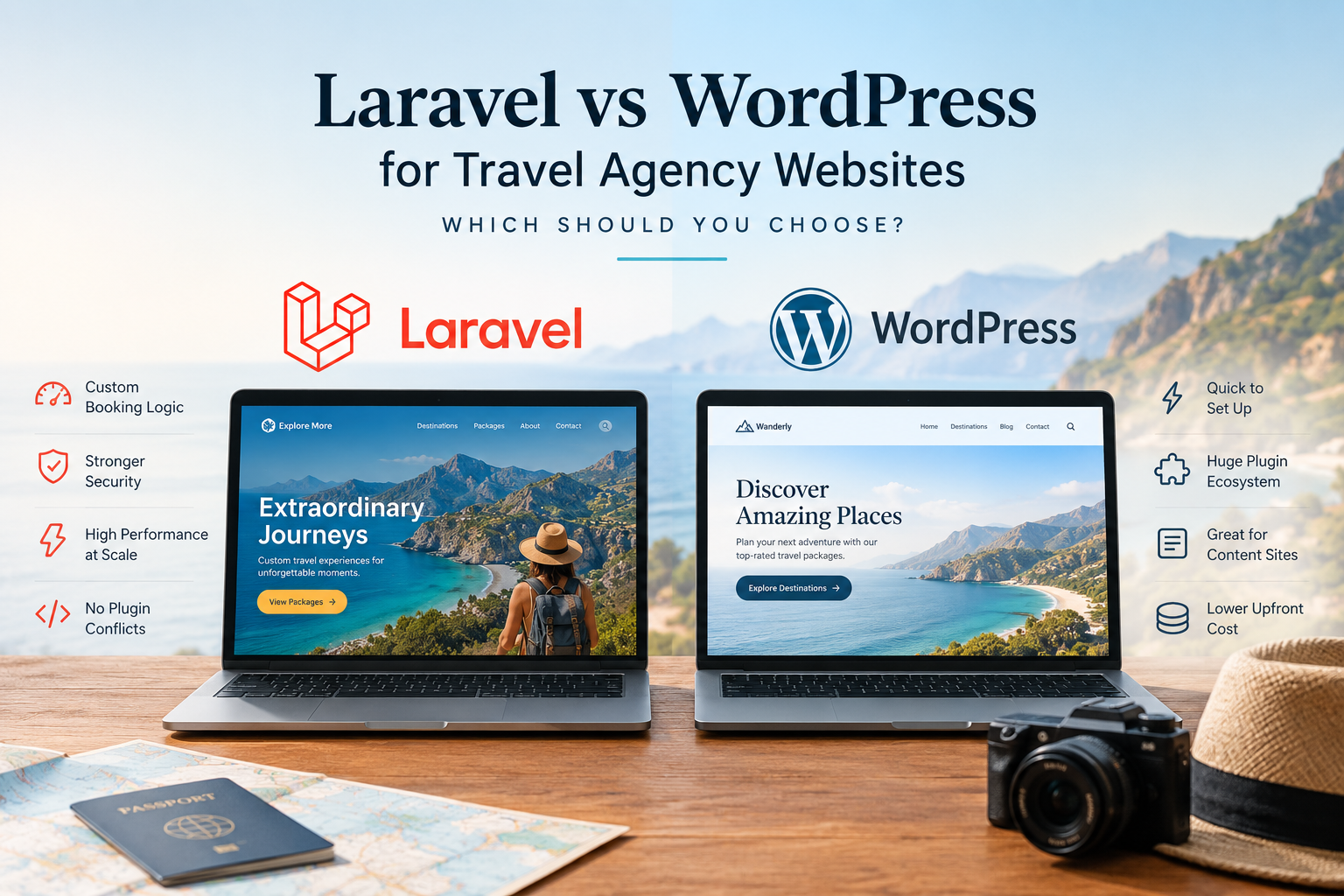
The SEO, WhatsApp chatbot, and booking engine integrations require a developer to implement properly. Attempting these without technical expertise typically results in slow load speed, broken mobile layouts, and misconfigured structured data — all of which hurt rather than help your rankings. See what to look for in the best web developer in Cape Town before you hire.
Continue Reading
Need help building your direct booking channel? Get in touch, explore services, or book a 1:1 consulting call.
LET’S TALK
Have a project in mind after reading this? Send a brief and I usually reply within 24 to 48 hours.