Back to journal
Web Development22 Sept 2026
Laravel vs WordPress for Travel Agency Websites: Which Should You Choose?
Tendai Gumunyu8 min read
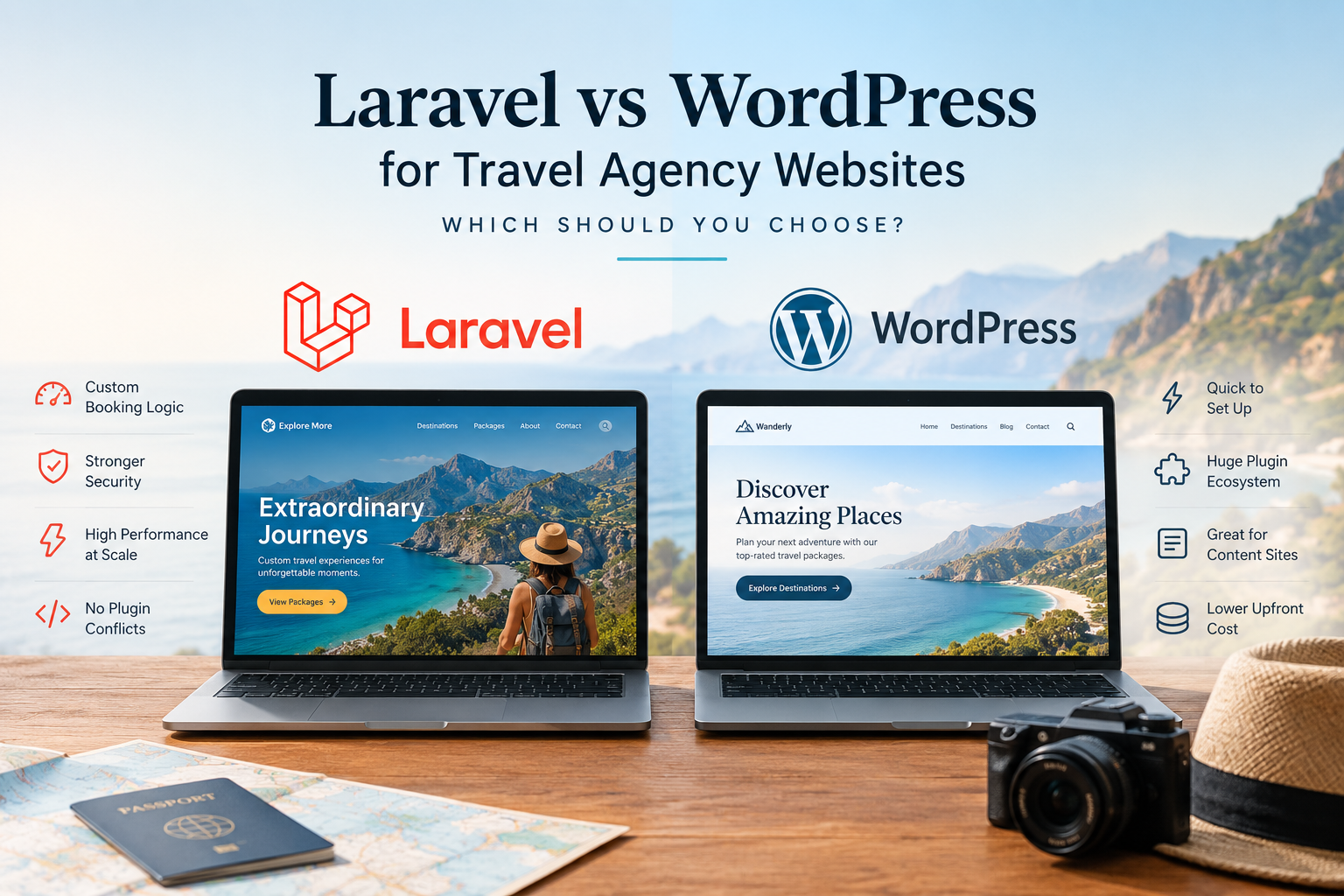
A clear comparison of Laravel and WordPress for South African travel agency websites, covering performance, custom booking logic, security, and which platform fits which type of agency.
Choosing a platform for a travel agency website is not just a technical decision, it directly affects how fast the site loads, how well it can be customised around your booking process, and how much it costs to maintain as the business grows.
This guide compares Laravel and WordPress specifically for travel agency use cases.
Why WordPress is the default choice
WordPress powers a huge share of the web, and for good reason.
It is fast to set up, has a massive ecosystem of themes and plugins, and there is a plugin for almost anything, forms, SEO, bookings, payments.
For a small agency that mainly needs a content-driven brochure site with a contact form, WordPress can be a genuinely sensible choice.
Where WordPress starts to struggle
The plugin ecosystem that makes WordPress flexible is also its biggest weakness once a site needs to do something specific.
A booking flow built by stitching together three or four plugins that were never designed to work together is fragile.
One plugin update can silently break another, and diagnosing the cause eats hours that should be spent running the business.
As plugin count grows, so does page weight and load time, which directly hurts both SEO rankings and conversion rate.
And because so much of the site's functionality lives inside third-party code you do not control, security patches and compatibility become an ongoing maintenance burden rather than a one-time setup cost.
Where Laravel becomes the better choice
Laravel is a PHP framework built for custom application logic rather than pre-packaged plugins.
Instead of stitching together tools that were never designed to work with each other, the booking logic, itinerary builder, or client portal is built exactly around how the agency actually operates.
For a growing or established travel agency, this translates into several concrete advantages:
No plugin conflicts.
There is nothing to conflict, because the core logic is custom-built rather than assembled from third-party plugins.
Performance at scale.
As the site grows, more packages, more images, more traffic, a purpose-built application stays fast, because there is no accumulating plugin overhead dragging down load times.
Real custom workflows.
Multi-step booking flows, admin dashboards for managing packages and availability, automated email sequences triggered by specific customer actions, these are straightforward to build properly in Laravel and are often clunky workarounds in WordPress.
Stronger security posture.
Fewer third-party plugins means a smaller attack surface, which matters significantly when the site is processing deposits, payment details, and personal client data.
Laravel vs WordPress: which fits your agency?
Choose WordPress if the site is primarily a content and brochure experience, informational pages, a blog, a simple contact form, with no need for custom booking logic or complex integrations.
Choose Laravel if the site needs to do something specific to how the business runs, a custom quote or itinerary builder, live availability, tight integration with a particular payment or booking provider, or a client portal.
Once the site needs to function like a piece of software rather than just display information, a custom-built foundation starts paying for itself in performance, security, and flexibility.
Frequently asked questions
Is Laravel more expensive to build than a WordPress site?
Generally yes upfront, because it involves custom development rather than plugin assembly.
That cost is usually offset over time through lower maintenance overhead, better performance, and functionality that would otherwise require expensive or unreliable plugin workarounds.
Can a WordPress site be migrated to Laravel later?
Yes.
Content and data can be migrated to a custom Laravel application once the business has outgrown what WordPress and its plugins can reliably support.
Which platform is better for SEO?
Both can rank well when properly configured, but Laravel's performance advantages at scale, faster load times and fewer plugin-related slowdowns, tend to give it an edge as a site grows in size and complexity.
Not sure which platform fits your agency's needs?
Get in touch for an honest assessment of whether WordPress or a custom Laravel build is the right foundation for your website.
laravelwordpressweb developmenttech stacktravel agency website
Work with me
Start a project →LET’S TALK
Have a project in mind after reading this? Send a brief and I usually reply within 24 to 48 hours.