Safari Lodge Web Speed: Designing for 3G Connections in Remote Bush Areas
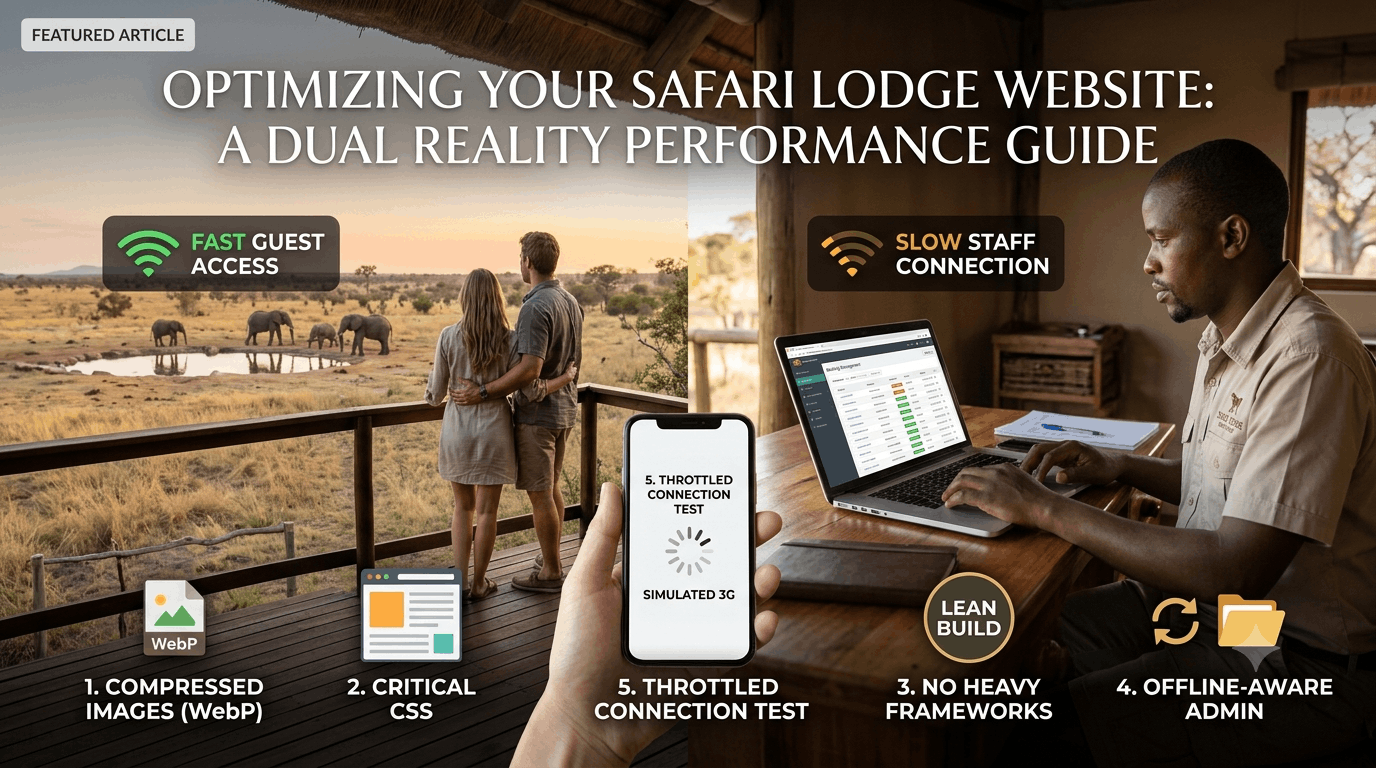
Your lodge staff often manage bookings over connections your web developer never tested against. Here's how to design and build a site that stays usable on genuinely slow 3G.
A luxury safari lodge deep in a private reserve can offer an extraordinary guest experience while running its back office on a connection that would frustrate anyone used to fibre. That is not a hypothetical, it is simply the reality of remote bush operations, and it means your website's performance budget cannot be designed around a developer's office wifi.
Guests researching your lodge from overseas usually have fast connections. Your own on-site staff managing bookings, updating rates, or checking enquiries often do not. A genuinely well-built safari lodge website has to work for both realities at once.
1. Compress and Convert Every Image
Large, uncompressed photography is the single biggest cause of slow load times on a lodge website, and lodge websites are almost always photography-heavy by nature. Convert images to WebP where supported, and set a firm compression standard rather than uploading photos straight from a camera at full resolution.
2. Generate Critical CSS for the First View
On a slow connection, every additional stylesheet the browser must fetch before rendering anything delays the first meaningful paint. Extracting critical, above-the-fold CSS and inlining it directly in the page head lets a visitor see something useful before the rest of the page catches up.
3. Avoid Heavy Client-Side Frameworks for Content Pages
A large JavaScript framework bundle downloaded before a page becomes interactive is a luxury only fast connections can afford. For content-heavy, largely static pages, a leaner build that does not depend on a large framework bundle keeps things usable even on a genuinely slow 3G connection.
4. Build an Offline-Aware Admin Experience
If lodge staff are managing bookings or content from the reserve itself, design the administrative side of the site to tolerate connection drops gracefully, saving drafts locally and syncing when connectivity returns, rather than losing an update mid-save.
5. Test on an Actually Throttled Connection
Do not estimate 3G performance from a fast office connection and a rough guess. Use your browser's network throttling tools to simulate a genuinely slow connection, and load your own site the way a staff member in a remote reserve actually would.
Speed is not a vanity metric for a safari lodge, it is an operational requirement. A site that only performs well in ideal conditions is a site that quietly fails the people running your business every single day.
LET’S TALK
Have a project in mind after reading this? Send a brief and I usually reply within 24 to 48 hours.