Connecting ResRequest to Modern Web Frameworks: An API Integration Guide
ResRequest holds serious safari logistics data, but its default web presence rarely matches a luxury lodge brand. Here's how a custom API integration bridges that gap.
ResRequest earned its place as the operational backbone of luxury safari travel portfolios for a good reason: it handles the genuinely hard problems, conservation levies, multi-camp transfers, complex child pricing, and offline-capable operations in places where connectivity is a luxury in itself. We compare it directly against NightsBridge and Semper in our booking engine comparison guide.
What it was not built to do is present that data beautifully on a modern, custom-designed website. That is where a direct API integration comes in, pulling live availability and rate data out of ResRequest and rendering it inside a frontend built specifically for your brand, rather than inside a generic default template. It is exactly what our ResRequest lodge website service is built around.
1. Understand What the API Actually Exposes
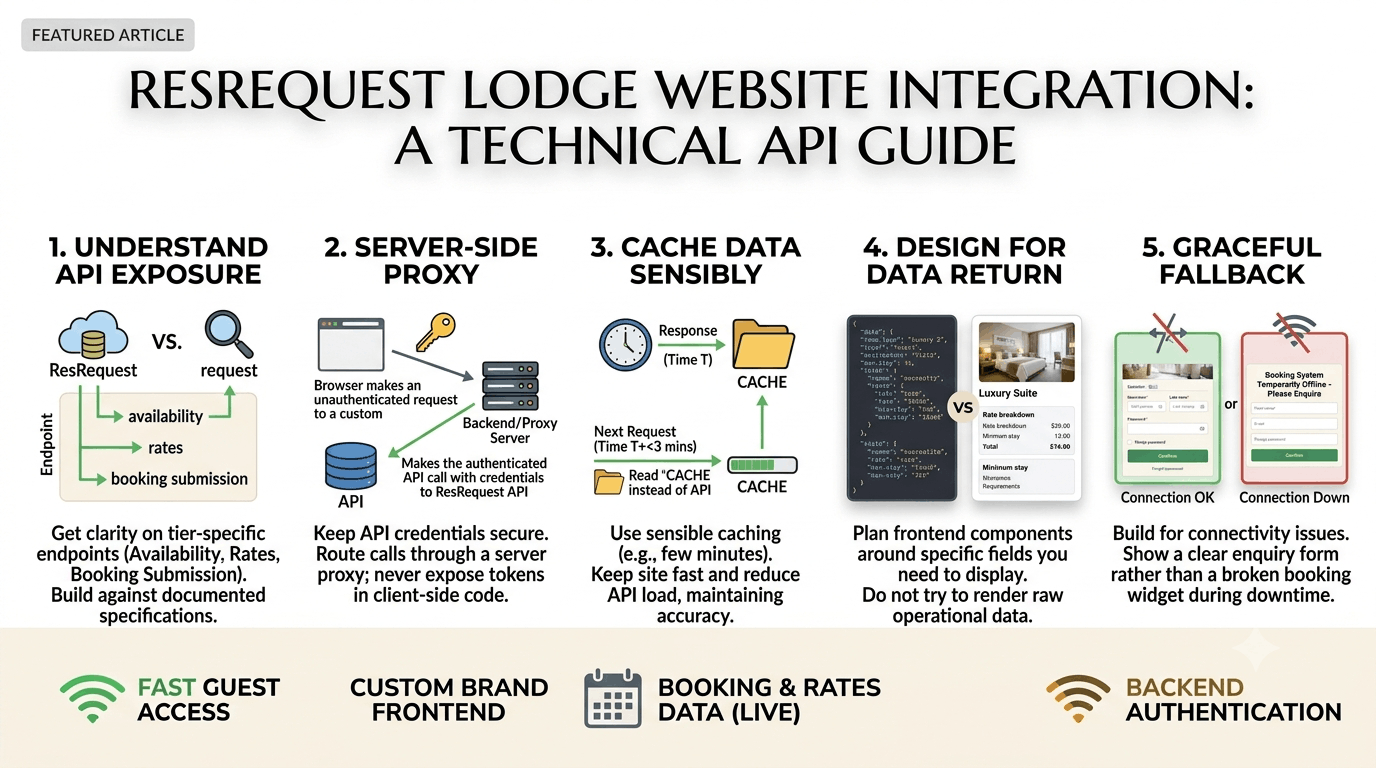
Before writing a line of frontend code, get clarity from ResRequest on exactly which endpoints your integration tier includes, typically availability, rates, and booking submission. Building against assumptions instead of documented endpoints is the single biggest cause of integration delays.
2. Keep API Credentials Server-Side, Always
ResRequest API tokens should never be exposed in client-side JavaScript where anyone viewing your page source could extract them. Route all API calls through a lightweight server-side proxy, so your frontend requests availability from your own backend, and your backend handles the authenticated call to ResRequest.
3. Cache Rate and Availability Data Sensibly
Live data does not mean every page load needs a fresh API call. Cache availability responses for a short window, a few minutes is usually enough, to keep your site fast and avoid unnecessary load on the ResRequest API, while still staying accurate enough for genuine booking decisions.
4. Design for the Data You Actually Get Back
ResRequest's response structures are built for operational completeness, not visual simplicity. Plan your frontend components around the specific fields you need to display, room type, rate breakdown, minimum stay, rather than trying to render the entire raw response and hoping it looks acceptable.
5. Build a Graceful Fallback for API Downtime
Remote lodge operations mean connectivity issues happen. Your frontend should degrade gracefully if the ResRequest API is temporarily unreachable, showing a clear enquiry form rather than a broken, empty booking widget.
Done properly, an API integration is invisible to the guest and invaluable to the operator: the operational power of ResRequest, wrapped in a browsing experience that actually matches the caliber of the lodge itself.
LET’S TALK
Have a project in mind after reading this? Send a brief and I usually reply within 24 to 48 hours.